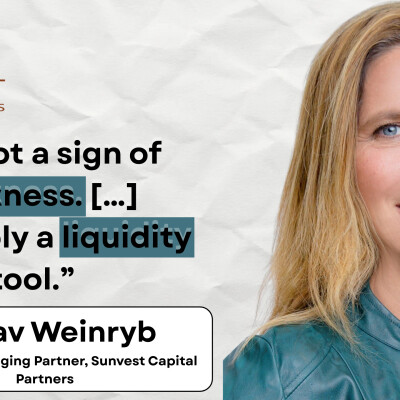
New episode out with Merav.
Former engineer.
Former investor at Pitango.
Former Intel Capital investor.
Nearly ten years at Qualcomm Ventures.
More than 25 investments and 13 exits.
Today, founder and Managing Director of Sunvest Capital Partners, focused on VC secondaries in Israel.
This wasn’t only a conversation about the secondary market.
It was a conversation about investing, liquidity, and how the venture capital ecosystem is changing.
We talked about her journey from engineering to venture capital, and how those different experiences shaped the way she looks at companies today.
When she invests, she does not only ask whether a company can become a large standalone business.
She also asks another question.
If this is not an IPO, who could be the acquirer?
We talked about her years at Pitango, Intel Capital and Qualcomm Ventures, how she assesses teams, products, markets and exit potential, and how AI is changing the way investors need to think about companies today.
We also talked about the Israeli tech ecosystem.
Why Israeli founders tend to move fast.
Why the US remains the main market for many Israeli startups.
Why so many global technology companies have built a presence in Israel.
And why being on the ground still matters when investing there.
Then we moved to secondaries.
LP interests.
GP-led transactions.
Strips.
Continuation vehicles.
Employee liquidity.
Founder liquidity.
A market that has changed significantly over the past few years.
Companies are staying private longer.
Exits are taking more time.
LPs are increasingly looking for DPI.
And traditional fund timelines do not always match the time needed to build and exit a company.
We talked about why direct secondaries are becoming increasingly common in venture rounds, why GP-led transactions are still misunderstood by many VCs, and why secondaries are gradually becoming part of regular fund management.
One point was particularly interesting.
For some GPs, selling an asset at a discount can still feel like a negative signal.
But for LPs, getting cash back today at a discount can sometimes be more valuable than holding an asset at a higher NAV with no liquidity.
Secondaries are not necessarily a sign of weakness.
They are a liquidity tool.
We also talked about why she decided to launch her own platform, why access and trust matter so much in the Israeli market, and how local knowledge can create an edge when underwriting companies and funds.
And finally, we talked about investing itself.
Why she prefers to invest in companies that do not need her.
Why the best investors need to know how to tell the story of an investment to someone who has never met the company.
And why young professionals should progressively build their own network, their own deal flow and deals they can truly call their own.
A lot of experience.
A lot of perspective.
And a very clear view of how venture capital and secondaries are evolving together.
Thank you Merav,
Voix de la Finance
Hébergé par Ausha. Visitez ausha.co/politique-de-confidentialite pour plus d'informations.




New episode out with Merav.
Former engineer.
Former investor at Pitango.
Former Intel Capital investor.
Nearly ten years at Qualcomm Ventures.
More than 25 investments and 13 exits.
Today, founder and Managing Director of Sunvest Capital Partners, focused on VC secondaries in Israel.
This wasn’t only a conversation about the secondary market.
It was a conversation about investing, liquidity, and how the venture capital ecosystem is changing.
We talked about her journey from engineering to venture capital, and how those different experiences shaped the way she looks at companies today.
When she invests, she does not only ask whether a company can become a large standalone business.
She also asks another question.
If this is not an IPO, who could be the acquirer?
We talked about her years at Pitango, Intel Capital and Qualcomm Ventures, how she assesses teams, products, markets and exit potential, and how AI is changing the way investors need to think about companies today.
We also talked about the Israeli tech ecosystem.
Why Israeli founders tend to move fast.
Why the US remains the main market for many Israeli startups.
Why so many global technology companies have built a presence in Israel.
And why being on the ground still matters when investing there.
Then we moved to secondaries.
LP interests.
GP-led transactions.
Strips.
Continuation vehicles.
Employee liquidity.
Founder liquidity.
A market that has changed significantly over the past few years.
Companies are staying private longer.
Exits are taking more time.
LPs are increasingly looking for DPI.
And traditional fund timelines do not always match the time needed to build and exit a company.
We talked about why direct secondaries are becoming increasingly common in venture rounds, why GP-led transactions are still misunderstood by many VCs, and why secondaries are gradually becoming part of regular fund management.
One point was particularly interesting.
For some GPs, selling an asset at a discount can still feel like a negative signal.
But for LPs, getting cash back today at a discount can sometimes be more valuable than holding an asset at a higher NAV with no liquidity.
Secondaries are not necessarily a sign of weakness.
They are a liquidity tool.
We also talked about why she decided to launch her own platform, why access and trust matter so much in the Israeli market, and how local knowledge can create an edge when underwriting companies and funds.
And finally, we talked about investing itself.
Why she prefers to invest in companies that do not need her.
Why the best investors need to know how to tell the story of an investment to someone who has never met the company.
And why young professionals should progressively build their own network, their own deal flow and deals they can truly call their own.
A lot of experience.
A lot of perspective.
And a very clear view of how venture capital and secondaries are evolving together.
Thank you Merav,
Voix de la Finance
Hébergé par Ausha. Visitez ausha.co/politique-de-confidentialite pour plus d'informations.