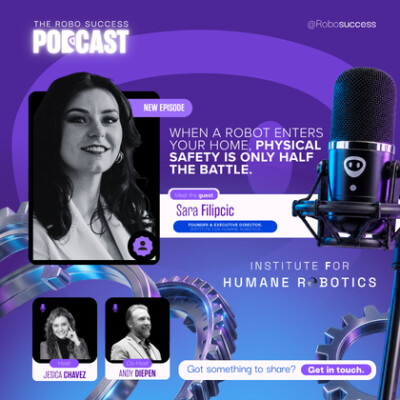
Welcome to Episode 19 of The Robo Success Podcast, where robotics meets real-world impact.
In this episode, we explore a critical question for the future of human-robot interaction: What happens when robots become part of our emotional and social lives?
Our guest, Sara Filipcic, Founder & Executive Director, Institute for Humane Robotics, shares insights into psychosocial safety, the emerging layer of robotics safety focused on how robots can influence human relationships, emotional well-being, and development.
🎙️ Guest: Sara Filipcic
🎙️ Host: Jesica Chavez
🎙️ Co-host: Andy Diepen
🔍 What you'll hear:
• Why physical safety standards may not be enough as robots become more integrated into daily life
• How over-attachment, anthropomorphism, and emotional dependency could shape human-robot relationships
• Why children and vulnerable populations require greater consideration when designing social and caregiving robots
• How cultural differences influence the way people perceive and interact with robots
• How the Institute for Human Robotics is working with IEEE to develop research, design guidelines, and standards for psychosocial safety
As robots move from controlled environments into homes, schools, healthcare, and caregiving, safety needs to account for more than physical harm. The challenge now is understanding how these systems may shape human behavior, relationships, and development over time.
Sara and the Institute for Human Robotics are working to bring researchers, engineers, universities, and industry leaders into that conversation before these systems become deeply embedded in everyday life.
More at: www.robo-success.com
Follow us to stay ahead in robotics, AI, and automation.
Hosted on Ausha. See ausha.co/privacy-policy for more information.




Welcome to Episode 19 of The Robo Success Podcast, where robotics meets real-world impact.
In this episode, we explore a critical question for the future of human-robot interaction: What happens when robots become part of our emotional and social lives?
Our guest, Sara Filipcic, Founder & Executive Director, Institute for Humane Robotics, shares insights into psychosocial safety, the emerging layer of robotics safety focused on how robots can influence human relationships, emotional well-being, and development.
🎙️ Guest: Sara Filipcic
🎙️ Host: Jesica Chavez
🎙️ Co-host: Andy Diepen
🔍 What you'll hear:
• Why physical safety standards may not be enough as robots become more integrated into daily life
• How over-attachment, anthropomorphism, and emotional dependency could shape human-robot relationships
• Why children and vulnerable populations require greater consideration when designing social and caregiving robots
• How cultural differences influence the way people perceive and interact with robots
• How the Institute for Human Robotics is working with IEEE to develop research, design guidelines, and standards for psychosocial safety
As robots move from controlled environments into homes, schools, healthcare, and caregiving, safety needs to account for more than physical harm. The challenge now is understanding how these systems may shape human behavior, relationships, and development over time.
Sara and the Institute for Human Robotics are working to bring researchers, engineers, universities, and industry leaders into that conversation before these systems become deeply embedded in everyday life.
More at: www.robo-success.com
Follow us to stay ahead in robotics, AI, and automation.
Hosted on Ausha. See ausha.co/privacy-policy for more information.