Women are already the primary decision-makers in household renovation and low-carbon upgrades. They manage timelines, handle budgets, research materials, anticipate health impacts, and carry the cognitive load of the entire process. The retrofit system, however, is not designed around them.
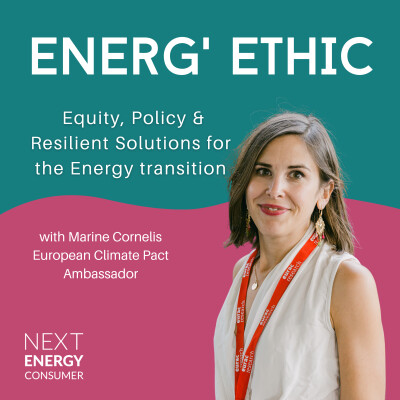
In this episode, Marine Cornelis speaks with Ellora Coupe, founder of Her Own Space, about the structural gap between where retrofit happens and how it is designed. The conversation examines why trust, not technology, is the real barrier to household action, why peer-based learning models fill a gap that institutional tools cannot, and what it would take for funding and policy frameworks to account for the full complexity of human-centred change.
This is a conversation about why retrofit moves slowly when it ignores who is already leading the work.
1. Trust as missing infrastructure. Retrofit faces a systemic trust deficit — not a communications problem, but a structural one. Households distrust contractors, product recommendations, and institutional schemes. Ellora argues that this trust erosion is the most underestimated obstacle to transition at scale.
2. The patronising design gap Women approaching retrofit are routinely not taken seriously as technical interlocutors. This is not incidental. It generates an invisible friction cost — eroded confidence, delayed decisions, abandoned projects — that no current scheme measures.
3. Community as a governance model Her Own Space is not a peer support forum, but a response to a specific governance failure: the loss of learning between individual retrofit journeys, and the incapacity of one-size-fits-all programmes to accommodate property diversity, budget variation, and different life stages. The community model absorbs complexity that institutional tools can't hold.
4. Sequencing without a single entry point Rather than prescribing a starting point, Her Own Space deliberately removes sequencing pressure. Members enter at any stage and learn across the full continuum of a retrofit journey. This challenges the design logic of most public-facing programmes, which rely on a single message reaching everyone at the same moment.
5. The early adopter argument — and what it means for policy Research cited in this episode suggests women adopt technology faster than men when it performs reliably, and abandon it faster when it does not. Designing for resilience is not the same as designing for uptake.
6. The agility gap in retrofit funding Innovation funding models are built around static, deliverable-defined outcomes. They can't accommodate iterative, community-embedded forms of innovation. Ellora argues this is a structural bias, and Her Own Space's membership model exists partly to avoid it.
Energ' Ethic goes out every other week.
Keep up to date with new episodes straight from your inbox
Reach out to Marine Cornelis via BlueSky or LinkedIn
Music: I Need You Here - Kamarius
Edition: Podcast Media Factory
Support Energ'Ethic on Patreon
© Next Energy Consumer, 2026
Hosted on Ausha. See ausha.co/privacy-policy for more information.


