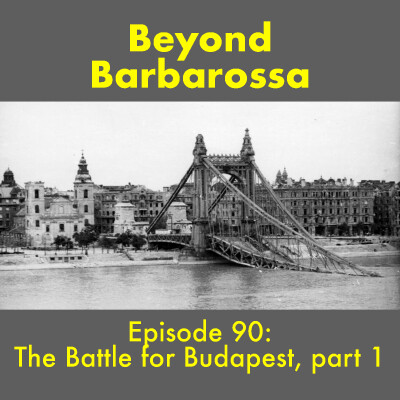
"Budapest lay athwart the main entry route to Austria and Bohemia. It was the main railway hub of the region and also the largest Danubian port. The Red Army could not bypass it. This was the first time in the war that the Red Army had to lay siege to a major city."
The Red Army assaults the capital of nazi Germany’s final remaining partner in the Second World War. The war appears to be almost lost—but that’s seen through hindsight. No one at the time knew that.
Map 1: The Eastern Front, December 1944
Map 2: Germany’s eastern and western fronts, 1 December 1944
Map 3: The Petsamo-Kirkenes operation in northern Finland
Map 4: The Red Army attacks BudapestOperation Konrad II
People
Mihai I, King of Romania, 1944–1947
Miklos Horthy, Regent of Hungary
Miklos Horthy Jr.
Ference Szalasi, nazi dictator of Hungary, 1944–1945
Edmund Veesenmayer, Hitler’s “Special Envoy” to Hungary, 1944–1945
SS-Obergruppenführer Karl Pfeffer-Wildenbruch, commander of IX SS Mountain Corps
Historical photos: Fighting in Budapest
Sources
Antony Beevor, The Second World War. New York, NY, USA: Little, Brown and Company, 2012.
Evan Mawdsley, Thunder in the East: The Nazi-Soviet War, 1941–1945. London: Bloomsbury Academic, 2016.
Anthony Tucker-Jones, Slaughter on the Eastern Front: Hitler and Stalin’s War, 1941–1945. Stroud, Gloucestershire, UK: The History Press, 2017.
Morse code by Thane Brown
Music composed and recorded by Nicolas Bury
Hosted on Acast. See acast.com/privacy for more information.
Hosted on Ausha. See ausha.co/privacy-policy for more information.
 Amazon Music
 Deezer
 Apple Podcasts
 iHeartRadio
 Listen Notes
 Pocket Casts
 Podcast Addict
 Podcast Index
 Podchaser
 Spotify
 Castbox
 Overcast
 Castro
"Budapest lay athwart the main entry route to Austria and Bohemia. It was the main railway hub of the region and also the largest Danubian port. The Red Army could not bypass it. This was the first time in the war that the Red Army had to lay siege to a major city."
The Red Army assaults the capital of nazi Germany’s final remaining partner in the Second World War. The war appears to be almost lost—but that’s seen through hindsight. No one at the time knew that.
Map 1: The Eastern Front, December 1944
Map 2: Germany’s eastern and western fronts, 1 December 1944
Map 3: The Petsamo-Kirkenes operation in northern Finland
Map 4: The Red Army attacks BudapestOperation Konrad II
People
Mihai I, King of Romania, 1944–1947
Miklos Horthy, Regent of Hungary
Miklos Horthy Jr.
Ference Szalasi, nazi dictator of Hungary, 1944–1945
Edmund Veesenmayer, Hitler’s “Special Envoy” to Hungary, 1944–1945
SS-Obergruppenführer Karl Pfeffer-Wildenbruch, commander of IX SS Mountain Corps
Historical photos: Fighting in Budapest
Sources
Antony Beevor, The Second World War. New York, NY, USA: Little, Brown and Company, 2012.
Evan Mawdsley, Thunder in the East: The Nazi-Soviet War, 1941–1945. London: Bloomsbury Academic, 2016.
Anthony Tucker-Jones, Slaughter on the Eastern Front: Hitler and Stalin’s War, 1941–1945. Stroud, Gloucestershire, UK: The History Press, 2017.
Morse code by Thane Brown
Music composed and recorded by Nicolas Bury
Hosted on Acast. See acast.com/privacy for more information.
Hosted on Ausha. See ausha.co/privacy-policy for more information.